.png)
In today’s fast-moving environment, disruptions rarely unfold as expected. Preparation requires more than planning. It requires understanding how decisions and coordination work under pressure.
ARMADILLO prepares any organization for business disruptions through realistic simulations that test response before real consequences manifest.
Most organizations have plans, yet few have tested how they perform when things go wrong. Disruptions impact more than operations; they jeopardize people, reputation, leadership credibility, and business continuity. When a response is untested, even well-designed plans can fail under pressure.
ARMADILLO Security helps organizations move beyond assumptions to understand how they will truly respond before real consequences exist.
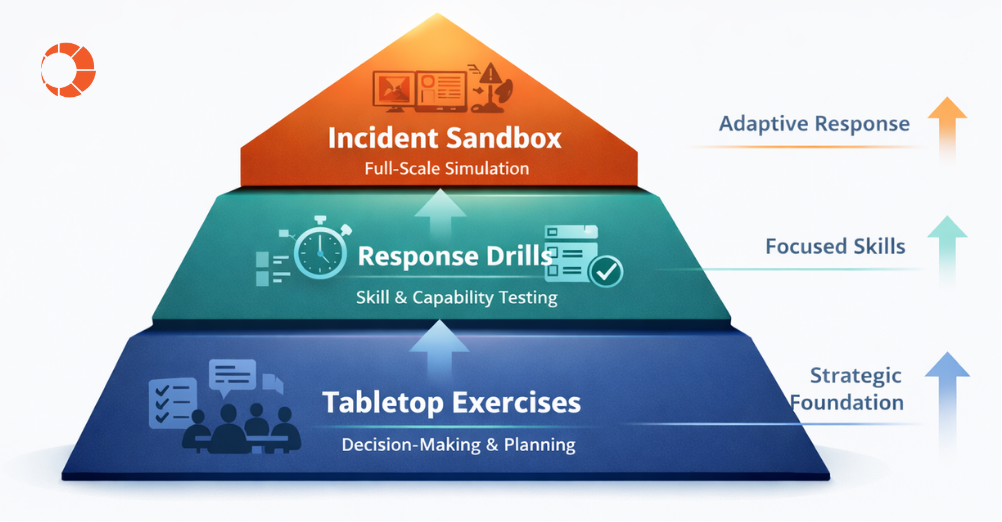
We use three levels of progressive, realistic simulation services to help organizations design, validate, and prove their ability to manage disruptions.
A discussion-based session where leaders and key teams walk through a realistic incident scenario to review decision-making, roles, continuity plans, and identify gaps before a disruption.
.png)
A focused exercise where participants test a single response capability or process under a simple, static scenario to validate response performance under realistic conditions.
.png)
A high-immersion, role-based simulation where multiple areas of the organization respond to a complex, evolving incident, testing coordination, leadership, and adaptability under pressure.
.png)
Who we Support
ANY organizations in ANY industry seeking to test how its critical processes perform under disruption.
Our simulations support teams responsible for:
• Safety and workforce protection.
• Operations and core business processes.
• Logistics and supply chain continuity.
• Legal and compliance decision-making.
• Communications and reputation management.
• Security and incident response.
• Leadership and executive coordination.
How it Works
1. Understand the organization, its priorities, and concerns.
2. Identify and structure disruption scenarios.
3. Select the right simulation approach.
4. Design and execute realistic exercises.
5. Evaluate performance, capabilities and identify gaps.
6. Deliver clear insights and practical recommendations.
No disruption to daily operations.
No unnecessary complexity.
.png)